kSuite vs Google Workspace, the honest comparison
kSuite Infomaniak or Google Workspace for your Mac? Pricing, encryption, jurisdiction, native Apple apps. The honest comparison, no marketing fluff.
Introduction
Every month, you fork out cash for Google Workspace. You’re a MacSouverain reader, so privacy’s a big deal for you. Eventually, the cognitive dissonance gets unbearable.
The question isn’t “Is Workspace bad?” It’s great, it’s the gold standard. The question is: what exactly are you paying for, and what are you trading for it? And is there an alternative that gives you your Mac, your jurisdiction, and your data back, without forcing you to downgrade?
kSuite, brought to you by Infomaniak from Geneva, makes that very promise. Let’s see if it delivers.
The Criteria That Matter
Comparing two collaborative suites without a grid is like doing a PR piece. Here are the six criteria I’ve chosen, and what I’ve deliberately left out.
Jurisdiction and Data Sovereignty. Where data is stored, under which law, who can access it legally. This criterion trumps everything else for MacSouverain because it’s structural and non-negotiable with features.
Real Encryption. Not “encrypted” in general. At-rest, in-transit, and especially end-to-end: who holds the keys. This is the only grid that withstands a warrant.
Price and Transparency. How much you pay per user, what you get, what changes when the editor does a “pricing update”.
Native macOS and iOS Integration. Apple Mail, Calendar, Contacts, Files. Can you work without installing a single app from the editor on your Mac. This is the “practical sovereignty” marker.
Professional Functional Coverage. Pro mail, shared drive, video conferencing, collaborative docs, admin console, SSO, MDM. A suite that forces you to keep another one nearby is a half-suite.
Exit Strategy. Export, standard formats, import from the competitor. You’re not married to your cloud provider, unless you choose to be.
What I DID NOT evaluate: very specific use cases (Workspace for Education, HIPAA compliance in the US, FedRAMP). If you’re an American hospital, this comparison isn’t for you. If you’re a European SME, a freelancer, or a family office, we continue.
kSuite, by Infomaniak
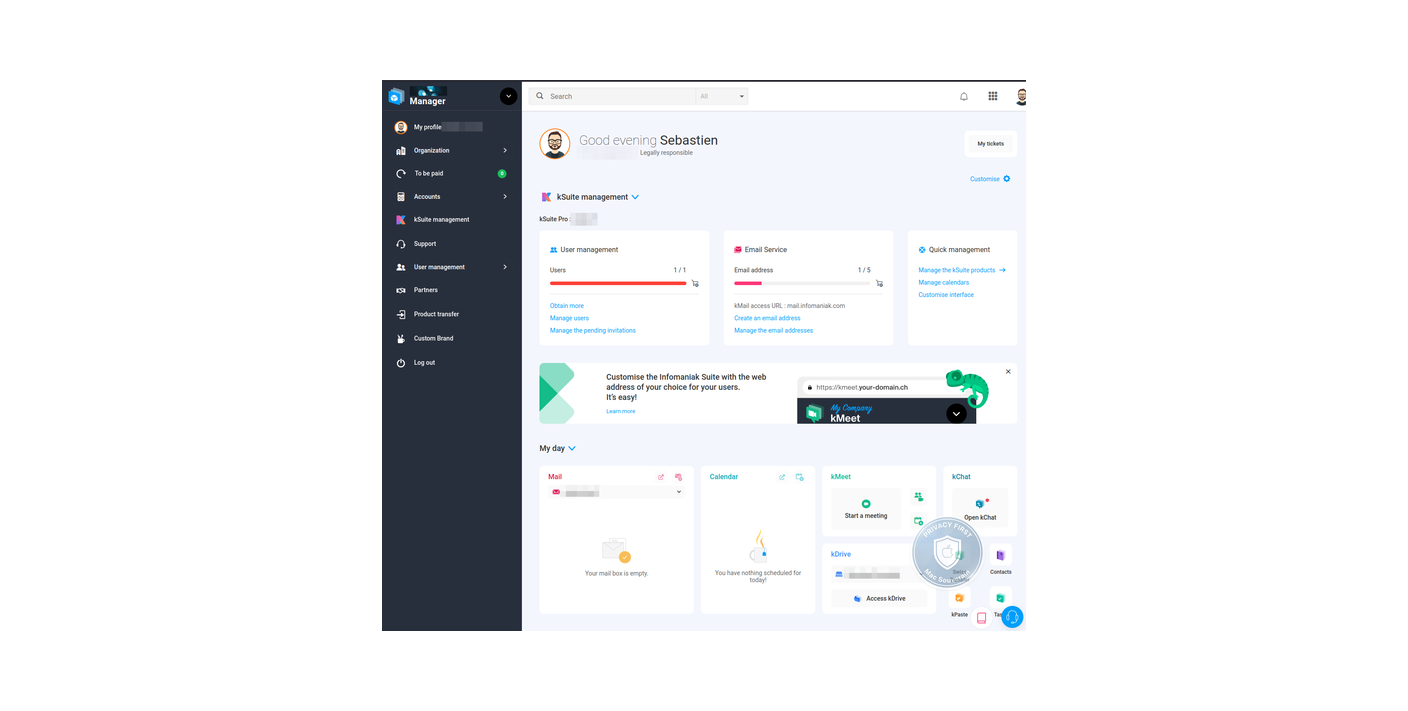
The philosophy in two sentences. A collaborative suite edited by a Swiss hosting provider of 316 employee-owned people, ISO 27001 and 14001 certified, operating its own datacenters in Geneva and Winterthur. Not a reseller slapping a UI on third-party bricks, a vertically integrated editor.
The strengths.
Swiss, no FADP, outside CLOUD Act. Infomaniak is under Swiss jurisdiction, governed by the new Federal Act on Data Protection (FADP, in effect since 01/09/2023). No CLOUD Act applies. Switzerland benefits from an adequacy decision for GDPR transfers. For an EU client or anyone attached to keeping their data from making a legal detour to Washington, that’s argument enough.
Built-in, free, transparent OpenPGP in kMail. Infomaniak enabled end-to-end encryption via OpenPGP in kMail webmail on June 17, 2025, for all plans, no add-on required. You enable, you exchange keys with your contact, your emails are encrypted end-to-end. Among major suites, only Proton and kSuite offer free OpenPGP in webmail. Google Workspace, Microsoft 365, and Zoho reserve their native encryption for Enterprise plans.
OnlyOffice under the hood of Docs, Grids, Points. The office suite engine in kSuite is OnlyOffice, AGPLv3, open source. High-fidelity compatibility with.docx,.xlsx,.pptx, better than Google Docs with native Office files. If your accountant sends you a.xlsx with macros and a wonky layout, OnlyOffice renders it correctly.
Open protocols everywhere. IMAP, SMTP, CalDAV, CardDAV, WebDAV. You configure Apple Mail, Calendar, Contacts, and Files.app without installing a single Infomaniak executable on your Mac. That’s rare, and it’s the purest integration criterion a cloud suite can tick.
kMeet with optional, free E2E. WebRTC video conferencing with optional end-to-end encryption activable when creating the meeting (shared key), documented by Infomaniak. Limited to Chromium browsers and desktop app, but it exists. Google Workspace’s equivalent (CSE) requires Enterprise Plus.
Transparent, stable pricing. kSuite Pro at 7.90 €/user/month for 3TB storage and full mail pro. No documented price increase since launch in 10/2022. The pricing promise holds.
The weaknesses.
MDM and Apple Business Manager: the gaping hole. No official ABM integration for kSuite. If you deploy a fleet of iPhones and Macs for business with federated authentication via Managed Apple ID, Workspace does it natively. kSuite requires a third-party MDM (Jamf, Mosyle, Kandji) with classic IMAP/CalDAV auth. It works, it’s less integrated.
Limited third-party marketplace. Google Workspace Marketplace has over 4,500 connected apps. kSuite has mostly Infomaniak suite and standard integrations. If your workflow relies on fifteen SaaS connected to Google Calendar, plan for a transition.
Mobile apps: solid, not reference. Infomaniak Mail and kDrive iOS are clean, but Gmail and Google Drive iOS remain the UX reference. It’s an experience gap, not a blocker.
Real-time co-editing: good, not excellent. OnlyOffice handles multi-user co-editing, but Google Docs is the absolute reference for latency and collaborative undo. If you spend all day simultaneously editing the same document with six people, you’ll feel the difference. Otherwise, not so much.
Euria vs Gemini. Infomaniak has its sovereign AI (Euria) for kMeet transcription and assistance. It’s decent, it’s not Gemini. If advanced AI-driven office suite is your top criterion, Google Workspace wins this point hands down.
Who it’s for. The freelancer, the SME, the family office, the liberal profession that wants a complete pro suite without CLOUD Act and without installing another proprietary app on their Mac. The MacSouverain profile, in short.
Prices (excerpts, real editor page on infomaniak.com/en/ksuite/ksuite-pro/prices).
- my kSuite : free, 20GB, 1 @ksuite.infomaniak.com address, kMeet included. No personal domain.
- my kSuite+ : CHF 5.75/month, 2TB, 1 domain + 5 aliases.
- kSuite Standard : 1.90 €/user/month, 15GB per user, pro mail with domain.
- kSuite Pro : 7.90 €/user/month, 3TB per user, pro mail + aliases, SSO SAML.
- kSuite Enterprise : 14.90 €/user/month, 6TB per user, advanced admin.
Google Workspace, by Google LLC
Philosophy in two sentences. The collaborative suite that redefined the standard since 2006. Market reference for Gmail, Docs, Sheets, and Meet, integrated with almost every SaaS worldwide, under US jurisdiction and CLOUD Act.
Strengths.
Reference anti-spam email. Gmail filters better than anyone else, period. Fifteen years of machine learning feedback on billions of messages, that’s hard to beat. If you switch email providers, your spam folder will miss you for two months.
Co-editing Docs, Sheets, Slides. The inventor of the genre is also the master of it. Latency, suggestions, mentions, granular history: Google Workspace’s online office suite remains the reference, and all other suites measure up to it.
Giant third-party ecosystem. Google Workspace Marketplace, 4,500+ apps. Your CRM, your billing, your HR tool, your ATS: they all have a native Google connector. For kSuite, expect manual CalDAV/IMAP integrations when the third-party app allows it, or nothing when it doesn’t.
Official Apple Business Manager. Federated authentication with Managed Apple ID, DEP token, MDM deployment Workspace Endpoint Management covering macOS, iOS, ChromeOS, Android, Windows. For an SME managing a heterogeneous fleet, this is a real operational argument.
Gemini AI integrated into all plans. Since March 17, 2025, Google has bundled Gemini into the core tariff of Workspace. NotebookLM, Gemini in Docs, Gemini in Sheets, Meet transcription: it’s powerful, and it’s available without additional add-ons.
Vault, eDiscovery, DLP, BigQuery audit. If your profession has legal retention, legal hold, or serious data loss prevention obligations, Workspace Plus and Enterprise are mature on these topics for ten years. kSuite has audit logs, not the full regulatory stack.
Weaknesses.
CLOUD Act, the structural argument. Google LLC is a US company, subject to the 2018 CLOUD Act, which allows US authorities to demand data stored anywhere in the world from a provider under US jurisdiction. “European datacenter” doesn’t change anything: Microsoft France confirmed this under oath to the Senate. Workspace is not qualified SecNumCloud by ANSSI. The partnership with Thales S3NS to carry a qualification is underway, Workspace itself does not carry it.
Price increase in 03/2025, Gemini bundle imposed. Google increased the core tariff of all Workspace plans by integrating Gemini into the package: +16.7% on Business Starter and Standard (annual), +22.2% on Business Plus. You don’t have generative AI in your workflow? You’re still paying. This is the second global increase after 2023, Workspace pricing is continuously increasing.
End-to-end encryption reserved for Enterprise Plus. S/MIME hosted and CSE (Client-Side Encryption) are only available in Enterprise Plus and Education Plus, with an external KMS to configure (Thales, Fortanix, Stormshield, Flowcrypt). On Business Starter, Standard, and Plus, you have TLS in-transit and AES-256 at-rest with Google keys. That’s not E2E.
Native Apple apps: it works, but not great. Apple Mail with Google Account works, but Gmail labels become IMAP folders, the experience is degraded. CardDAV is officially deprecated by Google in favor of People API (still functional via native Google Account iOS, but long-term signal). In practice, the Workspace user ends up opening Gmail web and Drive iOS app: the “100% native Apple apps” argument falls apart.
Gmail lock-in. Gmail’s labels, filters, categorization are specific. Google Takeout exports everything (.mbox, EML), but reformatting on the new provider’s side isn’t trivial. You can leave, but it won’t be comfortable.
Customer data vs AI training. Google contractually commits not to use Workspace B2B data to train Gemini. That’s a contractual commitment, evolvable, separate from the commercial Gmail consumer engagement (which does share signals). Keep an eye on this over time.
Who it’s for. The company whose critical workflows depend on the Marketplace, the large group with serious eDiscovery needs, the US client where local compliance requires Google certifications, the team already set up with no operational argument to move.
Prices HT (annual, editor page workspace.google.com/pricing).
- Business Starter: €6.80/user/month (annual), 30GB per user, Meet 100 participants, max 300 users.
- Business Standard: €13.60/user/month, 2TB pooled, Meet 150 + recording.
- Business Plus: €21.10/user/month, 5TB pooled, Vault eDiscovery, Meet 500.
- Enterprise: quote-based, 5TB+, Meet 1,000, CSE, advanced DLP.
Launch promotion: 50% off for the first 3 months for the first 20 users, then standard pricing applies.
Face-to-face on the criteria that matter
Instead of a flat table that levels everything, let’s look at the six criteria one by one.
Jurisdiction and sovereignty
kSuite is Swiss, under the Swiss Federal Act on the Surveillance of Post and Telecommunications (FADP), hosted in Switzerland (datacenters in Geneva and Zurich region), outside the CLOUD Act, outside the GDPR (but with a valid EU adequacy decision). Workspace is US, under the CLOUD Act, global datacenters with the “data regions” Europe option in Enterprise plans. On this criterion, it’s not a comparison, it’s a difference in nature. If jurisdiction is decisive for you, the subject is already settled.
Real encryption
kSuite: Native and free OpenPGP E2E in kMail, optional in kMeet, AES-256 at-rest on kDrive with Infomaniak keys. No native E2EE drive. Workspace: TLS and AES-256 at-rest everywhere, hosted S/MIME and Customer-Supplied Encryption in Enterprise Plus only, BYOK with external KMS in Enterprise Plus. For email, kSuite wins hands down and for free. For the drive, both ask for a compromise: Infomaniak keeps the keys, or you pay for Workspace Enterprise Plus to have CSE.
Price and transparency
At equivalent tiers, kSuite is cheaper everywhere. Solo 2 To: my kSuite+ at 5.75 € against Business Starter at 6.80 € for 30 Go (a factor of 70 in storage). SME standard: kSuite Pro at 7.90 € against Business Standard at 13.60 € (kSuite 42% cheaper, 50% more storage). SME premium: kSuite Enterprise at 14.90 € against Business Plus at 21.10 € (kSuite 29% cheaper). And Workspace pricing goes up, kSuite’s hasn’t changed since 10/2022.
Native macOS and iOS integration
kSuite exposes IMAP, SMTP, CalDAV, CardDAV, WebDAV. Apple Mail, Calendar, Contacts, Files.app work natively without a single proprietary app installed. It’s the “100% Apple” scenario pure and simple. Workspace also works natively, but the real experience pushes the user towards Gmail web and Drive iOS. On the criterion of “installing nothing from the vendor”, kSuite wins without moving; on the criterion of “polished experience”, Workspace keeps the lead with its own apps.
Professional functional coverage
Both suites cover email, drive, calendar, contacts, video conferencing, collaborative docs, admin console, SSO. Workspace adds native MDM, official ABM, Marketplace with 4500 apps, advanced DLP, Vault eDiscovery. kSuite adds high-fidelity OnlyOffice, free OpenPGP, E2E kMeet. On pure coverage, Workspace has more depth; on functional sovereignty, kSuite has an edge.
Exit possibility
kSuite exports EML, MBOX, vCard, iCal, native OnlyOffice files. Workspace exports via Takeout (mbox, vCard, ics,.docx via conversion). Both let you leave. kSuite makes arrival easier: it has a documented Workspace import in the Manager console. The reverse (leaving Workspace for something else) works technically but isn’t guided.
Mack’s Recommendation
I’ll say it straight up because that’s my job: if you have a choice, kSuite is better than Workspace for your Privacy.
Not because Workspace is bad. Workspace is an excellent collaborative suite. But the MacSouverain user isn’t the average Workspace user. The reader of this site is a freelancer, a European SME, a family office, an independent who pays for a service and wants to know who can read their files, who can force them to be communicated, and what happens when an audit arrives. On these three questions, Workspace answers “Google, the CLOUD Act, we’ll handle it”, and kSuite answers “you, nobody, and an export EML file”, total Privacy.
If you’re a freelancer or solo and budget matters. my kSuite+ at CHF 5.75/month for 2TB is an obvious choice over Business Starter and its 30GB.
If you’re a 5-50 person SME in Europe. kSuite Pro at €7.90/user. You save 42% compared to Business Standard, keep your pro mail with domain, can configure Apple Mail and Calendar on the whole fleet without installing an app, and you’re out of the CLOUD Act. The only question to ask: does your fleet need federated MDM via ABM? If yes, seriously evaluate the cost of a Mosyle or Jamf as a complement.
If you’re already on Workspace with your whole workflow tied to it. A migration costs. You don’t have to do it this quarter. But there are two moments when reconsidering it makes sense: every time Workspace raises its prices (the next one is coming), and when a critical workflow breaks due to a Google change. Both moments will happen, statistically.
If you’re a family office in Switzerland, Germany, or elsewhere in the EU and US jurisdiction bothers you. You don’t pay an American cloud to store your pro correspondence and financial documents, it’s as simple as that. kSuite is the shortest answer.
For my personal use, I made a different choice, Proton Workspace, which makes the same sovereignty promise from a different angle (E2E everywhere by default, complete Proton ecosystem). If you’re hesitating between the two sovereign worlds, remember this grid: kSuite has the edge on pure native Apple integration (standard CalDAV, CardDAV, IMAP) and high-fidelity OnlyOffice; Proton has the edge on systematic E2E and the cohesive app suite. Neither brings you back to the CLOUD Act, that’s the essential part.
In summary
kSuite is cheaper than its equivalent, more sovereign by design (Switzerland, nFADP, employee-owned, ISO 27001), exposes open protocols that make native Apple apps fully usable, and includes free OpenPGP encryption in mail. Workspace is more polished on Gmail, Docs, and third-party ecosystems, more integrated with Apple Business Manager, and much more mature on Vault and DLP topics, at the cost of a US jurisdiction and continuous price increases.
In practice:
- Freelance or solo, budget-conscious → my kSuite+ at CHF 5.75/month.
- European SME 5-50 people → kSuite Pro at €7.90/user/month, with a third-party MDM if needed.
- Critical Workspace workflow already in place → stay, prepare migration for the next pricing update.
- Heavy US regulatory compliance → stay on Workspace.
- EU family office, non-negotiable jurisdiction → kSuite, no hesitation.
Sources
The Editors Themselves
- Infomaniak, the employee-owned Swiss hoster from Geneva, has been editing kSuite since 10/2022. Product page, prices, and public ISO 27001 / 14001 / 5001 certifications.
- Google Workspace, Mountain View, under US jurisdiction and CLOUD Act. Pricing page, security whitepaper, public ISO 27001.
Technical Documentation
- kMail’s free OpenPGP announcement, picked up by Yahoo Finance on June 17, 2025.
- Apple Business Manager × Workspace, Apple’s official guide. Native Managed Apple ID federation on Google’s side, not kSuite’s.
Independent Analyses
- Wire, CLOUD Act vs EU sovereignty, Swiss messaging app Wire explains why a European datacenter isn’t enough if the company is US-based.
- 9to5Google, Workspace price hike 03/2025, tech press documenting the forced Gemini bundle and updated pricing grid.
Also see
- Digital sovereignty, in practice: the general grid of which kSuite is a case study.
- The cloud, it’s someone else’s computer: the mental framework behind this comparison.
- DNS, the Achilles heel of your privacy: same logic of jurisdiction on another layer.